

As mills across North America prepare for maintenance outages, now is the ideal time to include machine alignment and measurement in your maintenance strategy. During continuous operation, vibration, thermal expansion, and structural settling can gradually alter the alignment of rolls, frames, and drive systems. These subtle shifts often go unnoticed – until web stability problems, vibration, or quality issues begin to appear.
Including alignment in your outage plan helps restore machine geometry to OEM or process-specific tolerances, ensuring equipment operates efficiently and reliably once production resumes.
Why Alignment Belongs in Every Outage Plan
It Prevents Recurring Problems. Persistent process issues – wrinkles, tracking challenges, or tension imbalances – often stem from geometry drift rather than mechanical faults. Measuring and correcting alignment during a shutdown ensures new components integrate properly with existing ones, minimizing repeat failures.
It Protects Product Quality. Even minor angular or elevation deviations between rolls can change web tension and sheet properties. Verifying parallelism and centerline alignment (typically within ±0.005″ or 0.001″ per foot of roll face) helps maintain consistent moisture profiles and formation quality.
It Extends Component Life. Misalignment adds unnecessary load to bearings and couplings and reduces machine fabric operational efficiency. Correcting these conditions reduces vibration and wear, extending the life of high-value fabrics and parts, while lowering maintenance costs.
It Reduces Startup Delays. Proper alignment minimizes the trial-and-error that often follows startup. A geometrically correct machine helps operators reach target production speeds sooner and with fewer adjustments.
Where Alignment Delivers the Most Value
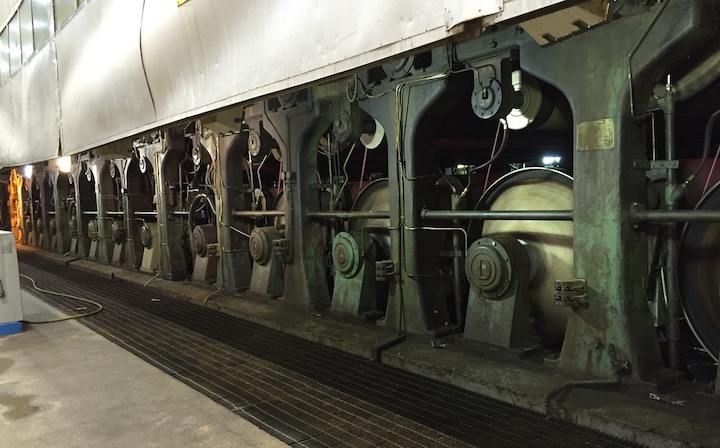
Every section of the paper machine benefits from precise geometry, but the following are particularly alignment-sensitive:
- Forming and Press Sections: Level and parallel components ensure proper sheet formation, uniform drainage, and even nip pressure, to optimize water extraction from the sheet.
- Dryer Section: Correct alignment eliminates uneven web tension, sheet breaks, felt tension and tracking issues, thus enhancing sheet drying capabilities throughout each dryer section.
- Calenders and Reels: Proper geometry maintains even nip loading and consistent roll build.
- Winders: At high speeds, alignment of winder components ensures proper torque, nip, and tension can be achieved while eliminating vibration, and roll set defects such as dishing and starring.
For a deeper dive into section-specific tolerances and alignment methods, see our article series on Precision Alignment During Paper Machine Upgrades & Conversions.
Modern Tools and Techniques
Today’s alignment professionals rely on laser tracker technology to measure large-scale geometry with high precision and efficiency. Instruments such as the Leica AT960 deliver high accuracy while providing three-dimensional data that can be analyzed in real time.
This data forms a permanent digital baseline of the machine, making future inspections and rebuilds faster and more reliable.
For larger systems and building structures, long-range laser scanning captures full 3D as-built conditions — invaluable for retrofit planning, interference studies, and documentation of legacy equipment.

You can learn more about how these technologies are used in our webinar: Paper Machine Alignment – Methods, Tolerances & Tooling, and in our PaperAge feature article on alignment’s role in extending machine performance.
When to Schedule Alignment
The most effective outage plans include alignment at three key stages:
- Pre-Outage: Conduct a quick survey to identify potential problem areas and plan corrective actions.
- During Outage: Perform realignment and verification while access is available.
- Post-Outage: Plan for inspections to be performed during a routine outage 6 to 12 months after alignment, especially after significant rebuilds. This ensures alignment of machine components has been maintained while capturing additional alignment data.
Proactive planning ensures the alignment team and mill maintenance crews can coordinate efficiently, avoiding schedule conflicts and ensuring adjustments are complete before startup.
When Alignment Leads to Repair or Machining Work
During alignment inspections, it’s not uncommon to uncover worn journals, damaged roll faces, or misaligned bearing fits that require precision machining or reconditioning. Having access to both field machining and in-shop machining capabilities ensures that corrective work can be completed efficiently and accurately—without delaying your outage schedule.
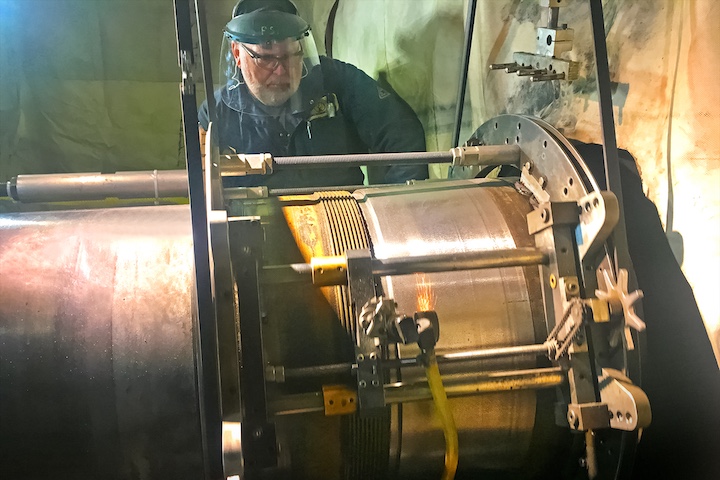
Field Machining Solutions:
Portable equipment enables technicians to restore geometry directly at the machine’s location—boring, flange facing, milling, or drilling large components without removal. This minimizes downtime and eliminates the need for heavy transport or disassembly during an outage.
In-Shop Roll Repair and Machining:
For larger or more complex work, dedicated shop facilities such as Western Machine Works or BR Machine, specialize in roll grinding, journal repair, shell replacement, dynamic balancing, and complete roll refurbishment. These services are critical for paper machines where roll surface finish and concentricity directly affect sheet quality, nip loading, and vibration. Reconditioned rolls are inspected, verified, and documented before returning to service—helping mills extend roll life and maintain tight OEM tolerances.
By integrating machining and alignment services, mills gain a seamless process—from precise measurement and diagnosis to complete, verified repair—reducing downtime between service steps and ensuring long-term mechanical reliability.
The Bottom Line
Machine alignment isn’t a one-time project — it’s a critical part of every maintenance cycle. By including it in your outage plan, you can:
- Restore original geometry and process consistency
- Reduce vibration and premature wear
- Extend the life of rolls, bearings, and machine fabric
- Shorten startup time and improve sheet quality
For additional insights, explore Precision Alignment During Paper Machine Upgrades & Conversions, and our Paper360° article on Winder Alignment for examples of how geometry impacts performance across the entire papermaking process.